

Feb 20, 2013
NEW ISSUE OF POESIS INTERNATIONAL

Feb 17, 2013
ALICE NOTLEY @ IVY PARIS
IVY vous invite à une lecture bilingue / Ivy invites you
to a BILINGUAL reading by

Alice Notley
and / et
Franck André Jamme
Suivi par
une performance poétique par Anna O,
accompagnée par Camille Ollivier à
la batterie
le
19 févier 2013
à 19h30
AU: CAFE DELAVILLE
34 bvd Bonne Nouvelle
75010 Paris
M° Bonne Nouvelle
www.delavillecafe.com
à 19h30
AU: CAFE DELAVILLE
34 bvd Bonne Nouvelle
75010 Paris
M° Bonne Nouvelle
www.delavillecafe.com
Feb 7, 2013
MICHAEL HELLER @ UNIVERSITE PARIS OUEST
« The Objectivists
Today »
A Seminar with American
poet Michael HELLER
Vendredi 8 février 2013
Organized by Hélène AJI for ELAN (Etudes
en Littérature anglaise et d’Amérique du Nord, CREA, EA 370), in collaboration with "Transferts Critiques et
dynamique des savoirs" (EA1569, Université Paris 8 Vincennes-Saint-Denis).
Université Paris Ouest Nanterre La
Défense, Bâtiment V, salle V 411 (4e étage).
14h-15h : « Now-Time Poetics:
Under the Sign of Benjamin »
Keynote lecture by Michael HELLER (New
York University).
15h-16h : « A Few Modes of
Objectivist Poetics »
Round table moderated by Brigitte FÉLIX
(Université Paris 8 Vincennes-Saint-Denis) with Fiona McMahon (Université de Bourgogne), Xavier KALCK (Université
Paris-Sorbonne) and Hélène AJI (Université Paris Ouest Nanterre La Défense).
16h-16h30 : Coffee and cookies
16h30-17h30 :
Bilingual poetry reading celebrating Michael Heller’s
This Constellation is a Name, Collected
Poems 1965-2010 (New York : Nightboat Books, 2012).

Michael Heller has published over twenty volumes of
poetry, essays and memoir. His newest book is This Constellation Is A Name: Collected Poems 1965-2010. Other
recent works include: Eschaton
(2009), a book of poems, and Beckmann
Variations & Other Poems, a work in prose and poetry (2010). His
collection of essays on George Oppen, Speaking
the Estranged, was published in 2008. An expanded edition was published in
2012.
His many awards and honors include
prizes from The New School for Social Research, Poetry in Public Places, the
New York State CAPS Fellowship in Poetry, the Alice Fay Di Castagnola Prize of
the Poetry Society of America, a New York Foundation on the Arts Fellowship,
the National Endowment for the Humanities and the Fund for Poetry.
For many years, he was on the
faculty of New York University and has taught at The Naropa University, The New
School, San Francisco State, Notre Dame and other universities. His papers are
collected in the Stanford University Libraries.
Feb 4, 2013
LINH DINH on RON SILLIMAN's blog

Jan 24, 2013
NOMADOSOPHY Reviewed by DORIS MIRONESCU for SUPLIMENTUL de CULTURA

Established literary critic and historian Doris Mironescu has shrewdly reviewed our latest collection for the Iasi-based cultural journal, comparing MARGENTO to a Transatlantic Cruise Liner. (Romanian)
Transatlanticul Tanasescu

Doris Mironescu
Nomadosofia, volumul poetic bilingv de peste 350 de
pagini publicat anul trecut de entitatea colectiva Margento (in fapt, de
poetul Chris Tanasescu, lider al grupului de poezie-pictura-jazz-rock
cu acelasi nume), este mai mult decit o carte. Este un eveniment care ar
trebui sa dea de gindit. Volumul se profileaza ca unul dintre virfurile
experimentale ale poeziei romanesti de astazi.Ocazia poate fi folosita pentru a incerca sa intelegem in cite moduri se (mai) poate experimenta cu poezia, ce limite sint de infrint, care perete considera poetul ca trebuie spart ca sa deschida orizontul prea ingust – caci acesta e rostul experimentului, sa redefineasca marginea, rupind-o.
In primul rind e de observat ca Tanasescu refuza identitatea de autor al Nomadosofiei, punind in fata numele colectiv al trupei sale: cartea e scrisa de “Margento”, iar anexa lamuritoare de la final prezinta “trupa si traducatorii”, o serie lunga de nume intre care nu apar doar componentii propriu-zisi ai formatiei de pictopoezie rock, ci si multi altii. Philip Levine, Robert Pinsky, O. Nimigean, Charles Simic, David Baker, Claudiu Komartin, Iulia Militaru apar in carte alaturi de alti contributori, precum Apollinaire, Ibn Battuta, Elizabeth Bishop, Salvatore Quasimodo, Hafiz, Frank Zappa... CITESTE MAI DEPARTE......
Jan 23, 2013
New Issue of ASYMPTOTE - January 2013
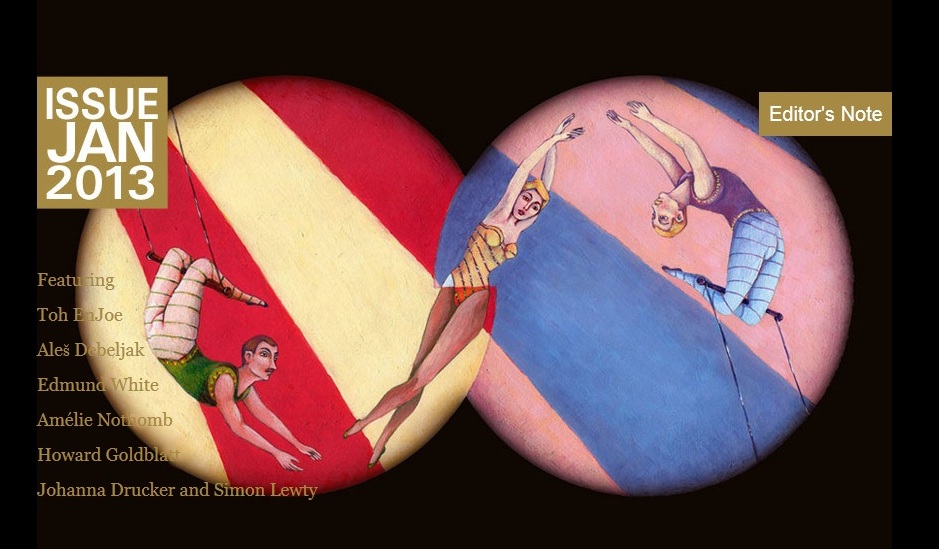
A new issue of this uniquely ample, innovative, and inclusive international zine!
Editor's Note
Well, hello there, 2013! We barely noticed you starting what with all the exciting developments here at Asymptote. Not only are we turning two, we're also celebrating with eight events in seven countries across the globe and launching our first ever online fundraiser! Now, you may ask, has this had any effect on the new issue? Only that it's even more chock-full of awesome! Still, some kidding aside, we really are proud to give you this, our ninth issue.
For one, we got to talk to our favorite Francophile, Edmund White, about why Proust is "a more profound psychologist than Freud". We also have an excerpt from the new novel by Amélie Nothomb, the Belgian phenom behind Fear and Trembling; Life Form is about yet another cultural clash—this time with an American soldier in Iraq. But perhaps we are proudest of bringing you the first ever English translation from Toh EnJoe's 2012 Akutagawa Prize-winning novel, Harlequin's Butterflies. In the fascinating interview Toh also granted us, the Physics PhD elaborates on his "un-local novels", and how we must cherish the ability to enjoy strange things.
Our poetry section begins with the blue of the sky in Dagmara Kraus's gloomerang and ends with the yellow of a mountain in Nicolas Pesquès' The North Face of Mount Juliau, Six. Inbetween, we have work spanning diverse eras and geographies, yet the unanimous concern for place—internal, external, historical, political, psychological—recurs with force. In Shrikant Verma's Magadh poems, place is marked by the vagaries of death; Aleš Debeljak's Smugglers is rooted in the Balkans; and Chuya Nakahara's Goat Songs are embedded in the elements. Many of the nine poets included in this issue consider just what place is and how we imagine it—how we encode it in language.
For the first time, our table of contents now has taster lines by all poets, as well as teaser images for the visual section. All the more suitable, as this issue sees the auspicious debut of our new Visual Editor, artist Simon Morley, who has collected an intriguing group of creators, all of whom work with text or language in crucial and intriguing ways. Simon Lewty, for instance, delves into tachygraphy (that's shorthand, FYI) to explore the act of writing and the nature of learning a language. The wonderful book artist Johanna Drucker, on the other hand, makes the intriguing claim that she too is a translator, albeit a graphic one. Performing her own graphic somersaults on the fiction, creative nonfiction and drama in our pages is our guest artist from Italy, Michela Caputo, whose playful, flowing style puts the icing on the cake of this 2nd anniversary issue.
As usual, there's a ton more, notably a small feature on the relationship between author and translator, with a generously personal essay by Howard Goldblatt on his relationship with Huang Chunming. Reif Larsen, the author of the widely acclaimed T.S. Spivet (translated into umpteen languages), returns to tell us about the crucial skills a translator must possess, not only through the interview he did with his Dutch translator, but also in a Wes Andersonian trailer we will be releasing shortly on our Facebook page and Tumblr. Other highlights include Uljana Wolf and Christian Hawkey's Ilse Aichinger translation, Dylan Suher's defense of Mo Yan, Vasily Grossman's visit to Armenia, and Gérard Mace's imagined (?) Museum of Shadows in Prague.
Before we leave you to discover this splendiferous new issue, we'd like to gently remind you to also check out our events and our fundraising campaign (also accessible from our newly revamped Donate page). And above all to spread the word, as there's so much more in store: after our African Feature in the Apr 2013 issue, our first ever Drama Feature in our July issue (check out the submission guidelines here), for instance, and an international translation competition that esteemed intellectual Eliot Weinberger just agreed to judge 2 days ago! (Details to follow.) Remember, you heard it here first.
 —The Editors
 MORE HERE!!!!!!!!!
Jan 22, 2013
JULIAN TALAMANTEZ-BROLASKI : PHONOSEMANTICS & THE REAL on the POEMS and POETICS blog

Read an amazing fragment from Julian Talamantez-Brolaski's forthcoming "Phonosemantics & The Real" and two poems from Advice for Lovers, on Jerome Rothenberg's blog:
From “Phonosemantics and the Real”
Shakespeare was almost
certainly homosexual, bisexual or heterosexual.
The sonnets provide no evidence on the matter. - Stephen
Booth, ed. Shakespeare's Sonnets.
If you look closely enough at
word, you'll find it contains its opposite.
George, porridge, Norwich,
porch and goy ridge all rhyme with orange. Why this antithesis between
decoration and use? Is a tiger less
efficient because of its stripes?
Plato's cloak was so magnificent that Diogenes leapt on it ...
Lucus a non lucendo – an
absurd conclusion, explanation or non sequitur.
Literally 'grove from not giving light,' i.e. a dark grove (lucus) is so called because it does not shine (lucere)—an illustration of the etymological procedure (see
Quintilian) of deriving a noun from another having a contrary sense
(Webster).
That art is thievery is a commonplace--lyre is homophonous w/ liar. This only coincidentally says something about poets... MORE HERE!!!!!!
Subscribe to:
Posts (Atom)


 Posts
Posts

